
What Does αw (Alpha-w) Mean?
αw (Alpha-w) is the weighted sound absorption coefficient defined by ISO 11654. It condenses frequency-dependent laboratory absorption data into one value, normally reported in 0.05
Explore practical guides to acoustic panel materials, thickness, sound absorption, installation and commercial applications. Learn what acoustic panels are made of, how panel thickness and mounting influence acoustic performance, why sound absorption differs from soundproofing, and how to compare PET felt, fabric-wrapped, wood slat, fiberglass, mineral wool and foam systems. Use the resources below to identify the right construction for your space or commercial project.

αw (Alpha-w) is the weighted sound absorption coefficient defined by ISO 11654. It condenses frequency-dependent laboratory absorption data into one value, normally reported in 0.05

A Noise Reduction Coefficient (NRC) rating is a convenient single-number summary of how much sound an acoustic material absorbs at four mid-frequency octave bands. It

Open ceilings, exposed services, glass façades, concrete floors, and large room volumes can create excessive reverberation in commercial interiors. Acoustic ceiling baffles for commercial spaces

Acoustic panels are made from porous, fibrous, perforated, or composite materials that reduce sound reflections inside a room. The most common types of acoustic panel

Akupanel and standard wood slat wall panels can look almost identical in photographs, but they are not automatically the same product. Akupanel is a brand

China is home to a broad range of acoustic panel manufacturers serving commercial interiors, education, hospitality, cinemas, studios, offices, and public buildings. For building materials

Hotel acoustics should begin with the type of noise problem—not with a product catalogue. Noise passing between guest rooms or through floors usually requires sound
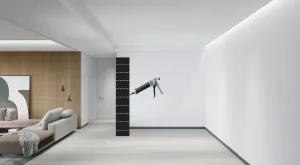
To install wood slat acoustic panels, first prepare and measure the surface, cut the panels to size, and then choose one of three fixing methods:

You can install a TV on acoustic wall panels, but the panels themselves should not be treated as the structural support. The TV mount must

If you sell a packaged product in the European Union, PPWR is the packaging-specific rule, REACH is the cross-industry chemical rule, and RoHS normally applies
Explore our acoustics knowledge base
Find clear answers about acoustic panel materials, thickness, sound absorption, soundproofing, installation and product selection. Follow the links to explore our detailed acoustic guides.
Acoustic panels can be made from PET felt, fabric-wrapped fiberglass or mineral wool, open-cell acoustic foam, or wood slats and perforated faces combined with sound-absorbing backing. The face material, acoustic core, thickness, air gap and mounting method can all influence the final performance.
Learn what acoustic panels are made ofProducts described as soundproof panels may combine dense boards, acoustic membranes, mineral wool, resilient layers and airtight seals. Decorative acoustic panels usually absorb reflected sound inside a room, but most do not block sound transmission through a wall, floor or ceiling by themselves.
Compare acoustic panels and soundproofing systemsFlexible sound-absorbing materials include some PET felt, open-cell foam and fibrous acoustic composites. They may be used on curved walls, columns, ceilings or custom interior features. Flexibility alone does not prove acoustic performance, so buyers should also review frequency-band absorption data, fire classification and the tested installation method.
Explore acoustic panel buyer guidesThe appropriate acoustic panel thickness depends on the panel material, target frequencies, mounting construction and room requirements. Thin panels may help control mid- and high-frequency reflections, while greater depth or a suitable air gap can improve absorption at lower frequencies. Always compare test results for the complete proposed assembly.
Review available acoustic test reportsNo. Acoustic panels primarily reduce echo, reverberation and reflected sound within a room. Soundproofing aims to reduce sound passing between different spaces and normally requires mass, airtight sealing and, in many cases, structural separation. Some projects need both sound absorption and sound isolation.
Understand the difference between absorption and isolationThe required quantity depends on the room volume, surface materials, occupancy, existing reverberation and target acoustic conditions. Early estimates can use several wall-and-ceiling coverage scenarios, but a commercial specification should be based on tested absorption data and the room’s acoustic target.
Estimate how many acoustic panels you needYes. Acoustic products can be installed as wall panels, ceiling panels, suspended clouds, vertical baffles or decorative architectural systems. The correct fixing method depends on the panel weight, substrate, fire requirements and the construction used in the relevant acoustic test.
Read the acoustic wall panel installation guideStart by identifying whether the project needs sound absorption, sound isolation or both. Then compare test data for the exact panel construction, frequency-band performance, fire classification, emissions documentation, durability, dimensions, finishes, installation requirements and production lead time.
Browse commercial acoustic panel buyer guidesShare your application, dimensions, quantity and performance requirements. Our team will review the details and get back to you.