
Acoustic panels are made from porous, fibrous, perforated, or composite materials that reduce sound reflections inside a room. The most common types of acoustic panel materials include PET felt, fiberglass, stone wool, mineral-fiber composites, acoustic foam, wood-slat composites, perforated wood or MDF, wood-wool cement, perforated metal, and perforated gypsum.
Each material behaves differently. Some maximize sound absorption, some provide a decorative finish, and others are selected for impact resistance, cleanability, fire performance, humidity resistance, or architectural integration. This guide helps architects, contractors, facility managers, and building-material buyers understand the differences before specifying or ordering acoustic panels.
Quick answer: PET felt is lightweight and design-friendly; fiberglass and stone wool are widely used as high-performance porous cores; foam is easy to shape; wood systems combine acoustics with a natural finish; wood-wool cement is robust; and perforated metal or gypsum suits integrated architectural ceilings and walls. The best choice depends on the complete tested assembly—not the material name alone.
Table of Contents
- What is an acoustic panel material?
- Comparison of 10 acoustic panel materials
- The 10 most common materials
- How to choose the right material
- Common mistakes
- Frequently asked questions
What Is an Acoustic Panel Material?
An acoustic panel material is the porous, fibrous, resonant, or perforated component used to absorb sound energy and reduce reverberation. A finished panel may combine several materials—for example, a fiberglass core, acoustically transparent fabric, metal frame, and mounting hardware. Therefore, “panel material” can describe either the absorption core or the complete panel construction.
Sound absorption is different from sound insulation. Absorbers control reflections within a space; sound-insulating assemblies reduce sound transmission between spaces. A thin wall panel can make speech clearer without “soundproofing” the wall.
ISO 354:2003 specifies reverberation-room measurement of sound absorption for wall and ceiling treatments. ISO last reviewed and confirmed this edition in 2024. When comparing products, use reports for the exact thickness, facing, air gap, backing, and mounting method.
Comparison of 10 Acoustic Panel Materials
| Material or panel construction | Main strengths | Important limitations | Common applications |
|---|---|---|---|
| PET polyester felt | Lightweight, colorful, CNC-cuttable | Thin sheets may have limited low-frequency absorption | Offices, schools, baffles, screens |
| Fiberglass board | Efficient porous core, broad product availability | Usually needs a protective facing or enclosure | Studios, offices, fabric-wrapped panels |
| Stone or mineral wool | Absorption, dimensional stability, fire-performance options | Fiber containment and finish must be considered | Ceilings, wall absorbers, baffles |
| Mineral-fiber ceiling tile | Economical modular ceiling format | Appearance and humidity resistance vary by grade | Offices, retail, classrooms |
| Acoustic foam | Lightweight and easy to shape | Fire, durability, and UV performance vary widely | Studios, equipment rooms, industrial uses |
| Wood-slat composite | Warm appearance plus absorptive backing | Performance depends on felt, spacing, and cavity | Hospitality, offices, residential interiors |
| Perforated or grooved wood/MDF | Durable architectural finish and tunable patterns | Heavier; requires a designed cavity/backing | Auditoriums, theaters, transport hubs |
| Wood-wool cement | Robust, textured, paintable | Rough appearance and greater weight | Schools, gyms, industrial-style interiors |
| Perforated metal | Durable, cleanable, suitable for demanding spaces | Metal face needs perforations and acoustic infill | Transport, industry, healthcare, ceilings |
| Perforated gypsum | Seamless architectural integration | Installation is less flexible than removable panels | Offices, halls, atriums, ceilings |
The 10 Most Common Types of Acoustic Panel Materials
1. PET Polyester Felt Acoustic Panels
PET panels are made from polyester fibers that are thermally formed into semi-rigid felt sheets. They can be installed as flat wall panels, ceiling baffles, clouds, screens, dividers, tiles, or CNC-cut decorative elements. Their light weight, color range, and relatively clean fabrication make them popular in offices, education, hospitality, and retail design.
PET performance varies significantly with thickness, density, air cavity, and installation. Kirei, for example, publishes NRC values from 0.30 to 1.05 across different thicknesses and mounting configurations for its PET panels, demonstrating why one headline number cannot represent every setup. Its specified product is 100% PET felt with at least 60% post-consumer recycled content, but recycled content is manufacturer-specific and must be documented. See leeyin PET panel data.

Best for: colorful, lightweight, customizable wall and ceiling treatments.
Check before buying: density, recycled-content evidence, color tolerance, fire report, VOC data, and the tested mounting method.
2. Fiberglass Acoustic Panels
Rigid fiberglass boards use fine inorganic glass fibers and a binder to create a porous sound-absorbing core. They are commonly wrapped in acoustically transparent fabric or installed behind a perforated finish. Fiberglass panels are widely used in recording rooms, offices, cinemas, classrooms, broadcast spaces, and commercial interiors.
Owens Corning describes its Type 706 and 707 acoustic boards as rigid rectangular boards made from inorganic glass fibers with a thermosetting resin binder. Their smooth surface is designed to accept fabric or coating for wall and ceiling applications. The published nominal densities are 96 kg/m³ and 112 kg/m³, illustrating that even within one material family, density and product purpose differ. See the Owens Corning technical overview.
Best for: fabric-wrapped absorbers and performance-focused acoustic treatment.
Check before buying: fiber containment, edge protection, fabric transparency, emissions, impact resistance, fire classification, and handling instructions.

3. Stone Wool or Mineral Wool Panels
Stone wool is a fibrous material used in ceiling tiles, wall absorbers, baffles, islands, and concealed acoustic infill. Its open structure allows sound to enter the panel and dissipate through friction. Products can combine high absorption with fire, moisture, mold, and dimensional-stability attributes, but these qualities must be confirmed for the exact product.
Rockfon’s stone-wool ceiling range shows how results change by panel type: Rockfon Artic is published at 0.75 NRC, while Rockfon Tropic is listed at up to 0.90 NRC. These are product-specific values, not universal ratings for all stone wool. Rockfon Tropic product data also illustrates the use of stone wool in modular commercial ceilings.
Best for: commercial ceilings, wall absorbers, spaces with demanding fire or humidity specifications.
Check before buying: surface facing, edge detail, suspension system, humidity rating, cleanability, fire report, and applicable acoustic test.

4. Mineral-Fiber Composite Ceiling Tiles
Mineral-fiber ceiling tiles are typically wet-formed composite products rather than a single homogeneous mineral. Depending on the manufacturer, their formulation may include mineral wool, fiberglass, perlite, cellulose or paper fiber, starch, and other binders or fillers. They are installed in exposed, semi-concealed, or concealed suspension grids.
These tiles are among the most common acoustic products in offices, shops, schools, clinics, corridors, and back-of-house spaces because they combine ceiling access, light reflectance, absorption, and economical modular installation. Performance and composition vary by product grade. An Armstrong Environmental Product Declaration for one Fine Fissured product, for example, lists perlite, paper, starch, fiberglass, and mineral wool in different proportions. View the Armstrong EPD.

Best for: accessible suspended ceilings and cost-conscious commercial projects.
Check before buying: NRC, ceiling attenuation, sag resistance, humidity limits, edge type, grid compatibility, recycled content, and replacement availability.
5. Acoustic Foam Panels
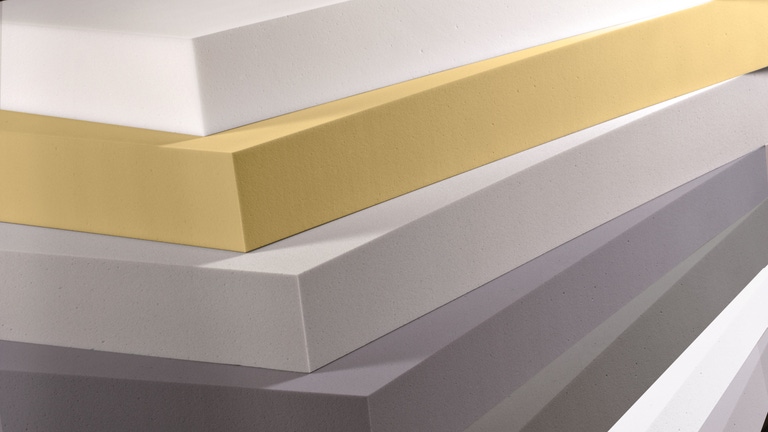
Acoustic foam is an open-cell polymer material supplied as flat sheets, wedges, pyramids, baffles, or sculpted forms. Polyurethane foam is common in entry-level studio treatment, while melamine-resin foam is used in architectural, transportation, and industrial applications where its particular fire and temperature characteristics are required.
The open cells allow sound waves to enter and lose energy within the internal structure. Thickness and air space matter more than decorative surface shapes alone. BASF describes Basotect as a flexible, open-cell melamine-resin foam with sound-absorption, low-weight, thermal-insulation, and flame-resistance properties. BASF’s Basotect technical overview also notes that product grades and fire behavior should be matched to the application.
Best for: lightweight absorbers, retrofits, shaped baffles, studios, equipment enclosures, and transport interiors.
Check before buying: polymer type, open-cell structure, thickness, fire and smoke test, UV resistance, surface durability, emissions, and cleaning limitations.
6. Wood-Slat Acoustic Panels with Felt Backing
Wood-slat panels typically combine veneered or laminated MDF slats with a PET felt backing. The slats create a linear architectural finish, while the exposed felt and optional cavity or insulation behind the panel provide absorption. They are popular in hotels, offices, restaurants, residential interiors, reception areas, and meeting rooms.
These are composite products, not solid wood absorbers. Performance changes with slat width, spacing, felt thickness and density, panel depth, air gap, and added mineral wool. WoodUpp’s Akupanel data sheet, for example, describes a 22 mm panel consisting of 13 mm MDF slats and 9 mm polyester felt; its published Class A result is tied to a test installation with 45 mm mineral wool behind the panel.

Best for: projects needing a warm wood appearance and moderate-to-high acoustic treatment.
Check before buying: real veneer versus foil, substrate grade, felt data, slat alignment, color variation, fire classification, and test build-up.
7. Perforated, Grooved, or Microperforated Wood/MDF Panels
These panels use holes, slots, grooves, or microperforations to allow sound energy to pass through a decorative rigid face. An acoustic fleece, air cavity, and mineral-fiber layer are commonly installed behind the panel. Pattern geometry and cavity depth help determine the frequency response.
Wood and MDF systems are used where durability, clean lines, and architectural finishes are important: auditoriums, theaters, lecture halls, airports, offices, and public buildings. Decustik explains that different drilling patterns produce different absorption at different frequencies. Its MICRO system uses 0.5 mm microperforations and recommends a rear plenum with mineral fiber, showing that the visible board is only one part of the absorber. See perforated wood systems.

Best for: high-finish architectural walls and ceilings.
Check before buying: perforation percentage, groove geometry, cavity, fleece, insulation, panel weight, substrate emissions, veneer, fire rating, access requirements, and full test curves.
8. Wood-Wool Cement Acoustic Panels
Wood-wool panels combine long wood fibers with a mineral binder, commonly cement, to form a rigid, porous board with a textured surface. They may be left natural, factory painted, or field finished. Their robustness makes them useful where soft fabric or exposed foam could be easily damaged.
This material is frequently found in schools, gymnasiums, multipurpose rooms, restaurants, industrial-style interiors, and open-structure ceilings. Some versions include an additional acoustic backer to improve absorption. Armstrong’s TECTUM High NRC wall panel, for example, adds a factory-applied acoustical backer to its wood-fiber panel construction. See Leeyin Wood-Wool Cement Acoustic wall panels.

Best for: durable, impact-conscious, textured interior applications.
Check before buying: binder type, thickness, density, edge finish, paint effect on porosity, impact requirement, fire report, mounting, and acoustic backer.
9. Perforated Metal Acoustic Panels
A solid metal sheet reflects sound, so an acoustic metal panel normally relies on perforations that expose a fleece, foam, fiberglass, or mineral-wool absorber behind the face. Steel and aluminum systems can provide high durability, precise modules, cleanability, corrosion-resistant finishes, and access to ceiling services.
They are common in transport hubs, industrial buildings, swimming or humid environments, hospitals, laboratories, sports facilities, and modern commercial ceilings. Knauf’s perforated metal Tegular example uses a 0.5 mm metal tile with black acoustic fleece; its published absorption varies with the specified configuration. See the Knauf metal acoustic panel.
Best for: demanding, cleanable, modular, or high-traffic spaces.
Check before buying: metal grade, corrosion protection, perforation pattern, infill, fleece, edge system, accessibility, fire compliance, cleanability, and condensation risk.
10. Perforated Gypsum Acoustic Panels
Perforated gypsum boards and tiles integrate sound absorption into continuous ceilings or wall linings. Holes or slots allow sound into the rear cavity, where acoustic fleece and optional mineral wool increase resistance and absorption. Gypsum systems can provide a more monolithic architectural appearance than exposed felt, fabric, or suspended baffles.
Knauf Danoline explains that its perforated gypsum ceilings use tile vibration, perforation resonance, and acoustic felt backing to address different parts of the frequency range. Perforations can also scatter sound, adding diffusion as well as absorption. Knauf’s technical explanation shows why perforation pattern and backing are integral to performance.
Best for: offices, lecture halls, lobbies, restaurants, atriums, and seamless ceiling designs.
Check before buying: perforation ratio, board type, jointing and paint system, rear fleece, cavity depth, insulation, access panels, humidity exposure, and complete-system fire and acoustic data.

How to Choose the Right Acoustic Panel Material
1. Start with the Acoustic Goal
Define the room problem before selecting a finish. A speech-focused classroom, reverberant restaurant, music studio, sports hall, and industrial enclosure require different frequency control, coverage, durability, and mounting. For critical spaces, an acoustic consultant should determine the target reverberation time and absorber area.
2. Compare Tested Assemblies, Not Raw Materials
An NRC or weighted absorption value belongs to a tested specimen and mounting condition. A 9 mm PET sheet glued to a wall, a 50 mm fiberglass panel, and a wood panel installed over a 100 mm cavity are not equivalent comparisons. Review the full report, not a cropped certificate or marketing headline.
3. Match Safety and Environmental Requirements
Confirm the applicable fire and smoke classification for the destination country, building type, wall or ceiling location, and installation. Also review VOC or formaldehyde emissions, fiber containment, ingredient disclosure, recycled-content evidence, wood chain of custody, and disposal options when relevant.
4. Consider the Real Service Conditions
Assess humidity, impact, cleaning chemicals, dust, UV exposure, access to services, ceiling loads, and maintenance. Soft felt may be ideal in an office but unsuitable beside sports activity. Perforated metal may work in a transport concourse but feel visually cold in a small hospitality room.
5. Calculate Installed Cost
Compare price per square meter only after including frames, battens, backing insulation, suspension, trims, fasteners, adhesives, cutting waste, freight, labor, inspection, and replacement panels. The lowest-priced face panel is not always the lowest-cost installed acoustic system.
Quick Specification Checklist
Use this checklist when requesting samples or quotations:
- panel material and complete layer-by-layer construction;
- dimensions, thickness, density, weight, and tolerances;
- surface finish, edge detail, color range, and cleanability;
- acoustic standard, full report, frequency data, and mounting condition;
- fire and smoke report for the exact construction;
- VOC, formaldehyde, recycled content, and wood-sourcing documents;
- wall or ceiling fixing system and allowable load;
- moisture, impact, UV, and maintenance limitations;
- MOQ, production lead time, warranty, packaging, and replacement policy.
Common Selection Mistakes
- Assuming every panel labeled “acoustic” has been laboratory tested.
- Confusing sound absorption with soundproofing.
- Comparing NRC values from different thicknesses or mounting methods.
- Selecting by appearance before defining the room’s acoustic target.
- Treating PET, stone wool, fiberglass, or foam as one uniform product grade.
- Ignoring what sits behind a perforated wood, metal, or gypsum face.
- Applying one fire certificate to different colors, finishes, cores, or assemblies.
- Forgetting cleaning, impact, humidity, access, and replacement requirements.
Frequently Asked Questions
What is the best material for acoustic panels?
There is no universal best material. Fiberglass and stone wool are common performance-oriented cores; PET offers design flexibility; foam is lightweight; wood systems provide architectural finishes; and metal or gypsum integrates into demanding wall and ceiling systems. The best choice meets the room target, safety requirements, service conditions, design, and budget.
Which acoustic panel material absorbs the most sound?
Absorption depends on the complete assembly rather than material name alone. Thickness, airflow resistance, facing, perforation, air gap, insulation, edge exposure, and mounting all affect results. Compare full frequency data from equivalent ISO 354 or ASTM C423 tests instead of selecting solely by the highest advertised NRC.
Are fabric-wrapped panels a separate acoustic material?
Fabric-wrapped panels are a finished construction, not one core material. The fabric is normally an acoustically transparent decorative and protective facing over fiberglass, mineral wool, foam, PET, or another absorber. Ask what is inside the panel and verify both the fabric and complete assembly for fire, emissions, durability, and acoustic performance.
Are wood acoustic panels really sound absorbing?
Wood faces can form effective absorbers when slat gaps, perforations, grooves, rear fleece, cavities, and fibrous backing are properly designed. A solid, unperforated wood sheet mainly reflects sound. Always check the tested construction because two visually similar wood panels can produce very different results.
Do thicker acoustic panels work better?
Greater thickness or a deeper air cavity often improves absorption at lower frequencies, but the relationship is not identical for every material or resonant system. Density, airflow resistance, perforation geometry, backing, and placement also matter. Use frequency-specific test data and project calculations instead of choosing thickness by a single rule.
Can acoustic panels soundproof a room?
Acoustic panels mainly reduce reverberation inside a room. Soundproofing requires a complete building assembly designed for mass, airtightness, isolation, and controlled junctions. Absorbers may form one component of that system, but wall-mounted panels alone should not be expected to stop significant sound transmission between rooms.
Conclusion
The 10 most common types of acoustic panel materials cover a wide range of priorities. PET, fiberglass, stone wool, mineral-fiber composites, and foam provide porous absorption in different formats. Wood slats, perforated wood, wood-wool cement, perforated metal, and perforated gypsum combine acoustic treatment with specific architectural, durability, or maintenance benefits.
Do not choose by material name or appearance alone. Define the acoustic objective, compare full test reports for equivalent assemblies, verify fire and environmental documentation, approve physical samples, and calculate installed cost. That process will identify the most suitable acoustic panel material for the space—and prevent expensive specification mistakes.


